
Given the abundance of financial regulations taking effect over the next 12 months, 2026 is shaping up to be the year that government-mandated electronic invoicing (e-invoicing) will finally take effect. Several countries will soon be moving forward with national requirements that enforce conversion to digital billing platforms. Their intent is to streamline value-added tax (VAT) collection, to better protect buyers, and to simplify and standardize business-to-business (B2B) payments, particularly those that cross borders.
To prepare your business for this shift, we’ll outline what e-invoicing is, discuss some of these upcoming changes, offer a global compliance timeline, and finally, explore how you can best navigate this new reality.
*Please note: E-invoicing regulations and mandate deadlines vary by country and are subject to frequent change. The information in this post reflects requirements as of March 2026 and may not reflect the most recent legislative updates, enforcement timelines, or compliance requirements in your jurisdiction. This content is intended for general informational purposes only and does not constitute legal, tax, or compliance advice. We strongly recommend consulting a qualified tax advisor or legal professional, as well as your local tax authority’s official resources, to confirm current requirements before making compliance decisions.*
* This image was generated using artificial intelligence*

How global e-invoicing is changing and what it means for your business
In contrast to more traditional, paper-based invoicing efforts, “e-invoicing” specifically refers to the process of creating, transmitting, and managing electronic billing requests in a structured, digital format. Under this new guidance, a scanned PDF or image file of a physical record would not qualify, but an invoice built using extensible markup language (XML) or universal business language (UBL) would.
With records stored and communicated in a digital format, users can transmit requests in real time by automating various billing functions using accounting software or enterprise resource planning (ERP) platforms. This shift not only allows organizations to improve accuracy and accelerate internal processes, but it also helps simplify external reporting and compliance with tax guidelines, such as those outlined in the the European Union’s (EU) VAT in the Digital Age (ViDA) initiative.
Key factors driving adoption in 2026
A majority of this pressure to move towards e-invoicing is being driven by impending mandates from a number of European countries. However, there are other countries, such as the United States, which do not have any nationwide laws enforcing a shift, but are still experiencing an uptick in e-invoicing adoption rates.
This increase in adoption is due in part to industry pressures, but also the belief that some form of mandate is inevitable. As global transactions continue to grow, e-invoicing has become more of a rule than an exception.
By transitioning to a more modern invoicing strategy, you can gain a distinct competitive advantage Some of the advantages of e-invoicing include:
- Lowered operating costs
- Accelerated cash flow
- Improved traceability
- Simplified tax compliance
- Enhanced scalability
- Hardened security
What it means for your business
While e-invoicing is poised to have a global impact, it’s current impact still depends on where your business operates. This means that before you make a decision on your e-invoicing strategy, you should first review current or pending legislation. Some regions only mandate using this technology when working with public agencies or for companies over a certain size. If your business is just starting out, only works with local customers, or deals with larger, less frequent sales, a shift to e-invoicing may not be the most cost-effective use of your current budget.
Ultimately, you’ll need to research and verify which regional or local guidelines apply to your organization and take measures to meet any and all compliance deadlines.
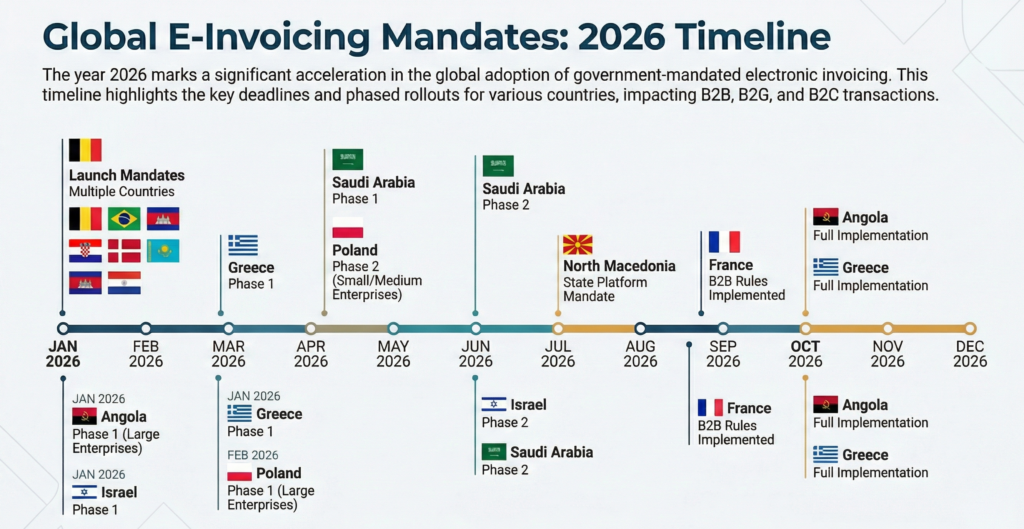
Timeline of global e-invoicing by country
While this list is not exhaustive, we’ve outlined what mandates you can expect to take effect in 2026. These dates change frequently, so be sure to verify any e-invoicing requirements and deadlines with the appropriate regulatory or tax agencies before taking action.
Country | Pending mandates | Starting date |
Angola | All domestic businesses will need to use e-invoices for most sales of goods and services and all sales made to public agencies. | Jan 2026 – large enterprises |
All VAT-registered businesses based in Belgium will need to use e-invoices for domestic B2B transactions. | Jan 2026 | |
Brazil | As part of sweeping reforms for indirect taxes, all domestic businesses and foreign businesses selling to Brazilian consumers will need to modify existing mandated e-invoicing systems to accommodate two new tax types. | Jan 2026 |
All nationwide public agencies, select regional agencies, and any suppliers billing these offices will need to use e-invoices. | Jan 2026 | |
All VAT-registered domestic businesses will need to use e-invoices for all domestic B2B transactions. | Jan 2026 | |
All businesses with a net turnover of more than DKK 300,000 in the two preceding accounting years will need to use government-certified e-invoicing solutions for their billing efforts. | Jan 2026 | |
All VAT-registered large- and medium-sized businesses will need to use e-invoices and e-reporting for domestic B2B transactions, regardless of established location. | Sept 2026 | |
All businesses under the authority of Greek Accounting Standards will need to use e-invoices for all domestic B2B transactions and any exports to non-EU countries. | Feb 2026 – enterprises with annual gross revenue exceeding €1 million | |
Israel | All B2B transactions exceeding the given financial thresholds will need to be processed as an e-invoice and routed through the Israel Tax Authority in real time. | Jan 2026 – transactions exceeding NIS 10,000 |
Kazakhstan | All VAT-registered businesses based in Kazakhstan will need to use e-invoices for most B2B transactions. | Jan 2026 |
All government-to-government (G2G), business-to-government (B2G), and government-to-business (G2B) transactions will need to use e-invoices and be submitted to the state revenue service. | Jan 2026 | |
All domestic businesses with an annual turnover of more than RM 1 million will need to use e-invoices for all B2B, B2G, business-to-consumer (B2C), and international transactions. | Jan 2026 | |
North Macedonia | All tax-paying businesses will need to use the state-run e-Faktura e-invoicing platform for all non-cash invoices. | July 2026 |
Paraguay | All businesses selling to public agencies will need to use e-invoices for these transactions. | Jan 2026 |
All businesses with a physical presence in Poland will need to use e-invoices for all B2B transactions. | Feb 2026 – large enterprises | |
All VAT-registered businesses will need to use e-invoices for all B2B, B2G, and B2C transactions. | March 31, 2026 – enterprises with annual revenues exceeding SAR 750,000 |
How to prepare your business for the switch
Whether or not you operate in any of the countries listed above, it’s likely that some form of legislation or industry guidelines will touch your billing efforts in the near future. So rather than waiting for the last minute, you should heavily consider migrating to e-invoicing software now to save you all-too-valuable time, money, and energy.
If you choose to prepare your business for the switch, we recommend that you:
1. Know what’s expected and pinpoint any shortfalls
When is e-invoicing mandatory for your business? Whenever the government says it is. Not only should you have a thorough understanding of what’s currently expected from your organization for the sake of regulatory compliance, but you should also be proactively monitoring and preparing for any upcoming rule changes. Fortunately, these updates will likely be covered in local press, financial journals, and in messaging from industry associations, ensuring that you don’t fall behind.
As these mandates continue to arise, compare them against your existing processes and identify any policy or reporting gaps that may exist. This task will be much easier if you’ve already standardised and documented your billing and dunning operations. If you haven’t done so yet, this should be your first step.
2. Assess your current invoicing / ERP / accounting setup
Next, determine if the A/R processes and technologies you already have in place will be able to meet these new mandates. This includes asking questions such as the following:
- Is our reporting sufficiently granular?
- Can we accurately set aside taxes for every region we sell to?
- Can we easily migrate our invoicing data across billing, accounting, and other back-office systems?
- Do we have sufficient computing resources in place?
If you can already accommodate these regulatory changes, great. No further action is required. More likely, though, you’ll need to invest in new technology, particularly if you’re still using manual or paper-based processes. This need presents an opportunity to drive increased value throughout your entire A/R operation.
Review your current systems to identify any recurring process bottlenecks or delays. Ask yourself:
- Are we duplicating any efforts?
- Can we scale operations adequately to keep up with peak sales periods?
- Do we have any manual operations still in place?
If there are any other shortcomings or opportunities for improvement, it would be wise to record those as well.
3. Evaluate the market and select the right technology and partners
Now that you know what limitations you’re facing, prioritize these needs in order of importance and begin researching what e-invoicing solutions are available. Identify key features or capabilities that can assist you in your compliance journey.
We recommend you look for automation platforms that can process, transmit, and report on invoicing operations in real time. And to preserve the value of your existing software investments, you should also find one that delivers broad integration support automatically. Alternatively, you might consider systems that offer open application programming interface (API) access, which makes it easy to surface these new e-invoicing capabilities within your existing accounting dashboards.
Beyond the current capabilities of the offering, you should also consider its development roadmap. Here are a few questions to consider:
- Is the provider actively updating and improving the software?
- Are they equally aware of upcoming global regulations?
You don’t want to anchor your future billing efforts to a solution that can’t keep up with the changing landscape, forcing your team to go through the selection process again in a few years. Instead, be sure to do your research before making your final choice.
4. Build a migration schedule and ongoing compliance plan
Once you’ve decided on your new e-invoicing solution, you’ll want to migrate your operations as quickly and smoothly as possible. Coordinate your technology and accounting teams with the software provider to map out your timeline, as well as set clear, achievable milestones for the transition. You’ll want to be sure to set any deadlines well before any new regulations or worse, non-compliance penalties, take effect.
Moving forward, your team should put an ongoing compliance plan in place that involves proactive research on upcoming legislation, routine evaluations of existing operations, and regular discussions about process shortfalls.
How Invoiced by Flywire can help with e-invoicing mandates
If you want to hold off on embracing the future of billing until mandates take effect feel free! But be aware that the longer you wait, the more you risk harsh government penalties that could effect your bottom line. If you’d like to move forward with e-invoicing for your business, we recommend that you consider Invoiced by Flywire’s Accounts Receivable Automation platform.
Our software streamlines billing and dunning while offering a flexible platform that integrates seamlessly with most leading ERP, sales, and customer management systems. It also provides advanced reporting capabilities to simplify compliance and auditing. With the global payment capabilities of Flywire software, you can now send invoices, collect payments, and more easily meet tax requirements across 140 currencies in 240 countries and regions.
If you’re ready to embrace the future and make e-invoicing a reality in your A/R, schedule a demo of our software today.